With the continuous development of automated equipment, industrial robots, and smart manufacturing, the application demand for speed reducers is also gradually increasing.
As products move towards higher precision, higher value, and export markets, manufacturers are no longer only concerned with product performance; transportation safety, plastic reduction in packaging, and sustainability requirements are also becoming important issues.
Therefore, speed reducer packaging is moving from simply providing "collision protection" to a new direction that balances fixation, protection, and sustainability.
Why do we need to rethink the packaging of speed reducers?
Gearboxes typically have a certain weight, and different models vary in size, center of gravity, and shape.
During long-distance transportation, transshipment, or export, if the product is not securely fixed, it may increase the risk of damage due to shaking, sliding, or collision.
Therefore, what really needs to be solved in reducer packaging is not just "whether there is buffer material", but:
- Can it stably support the weight of the product?
- Can displacement during transportation be avoided?
- Can it protect shaft ends, flanges and other protruding parts?
- Can the packaging structure be adjusted according to different models?
As a result, industrial packaging has begun to shift from "filling" to placing greater emphasis on "structural fixation".
Traditional plastic packaging is beginning to face the need to reduce plastic use.
In the past, speed reducers and mechanical parts often used polystyrene, EPE or plastic foam as linings, mainly to absorb impact and fill space.
These materials still have their suitable applications, but as companies place greater emphasis on ESG, packaging recycling, and plastic reduction, the standards for packaging assessment are also beginning to change.
For export-oriented manufacturers in particular, in addition to product protection, they also increasingly need to consider:
Is it possible to reduce unnecessary plastic use while maintaining safety?
This is also why paper-plastic packaging materials are gradually gaining attention in the industrial market.
Paper-plastic packaging materials: from consumer products to industrial parts
Paper-plastic packaging materials were previously commonly used in 3C, home appliances and consumer products, but with the maturity of structural design and molding technology, their application scope has gradually extended to mechanical parts and industrial products.
Among them, the reliable and environmentally friendly wet-pressed paper-plastic is shaped by high-temperature and high-pressure molds before the pulp dries, which can form a finer, smoother and less fuzzy surface. This helps to reduce the shedding of paper fibers and paper dust, and is more suitable for precision parts applications that require high quality of packaging contact surfaces.
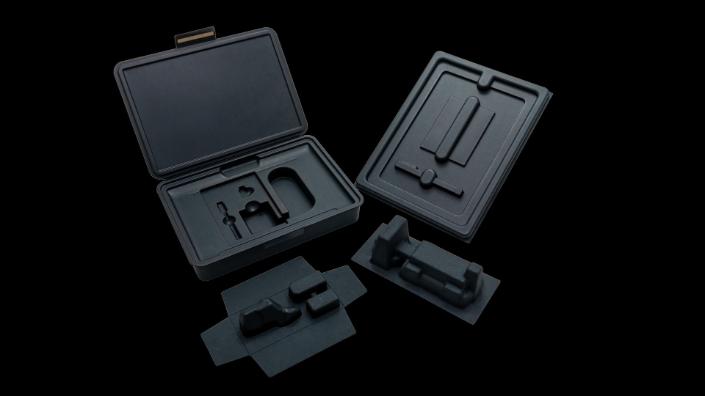
Through customized design, paper-plastic can be used to create grooves, support surfaces, and fixed positions according to the product's shape, reducing the likelihood of the product sliding or colliding inside the box.
Through customized design, paper-plastic composites can be custom-made with grooves, support surfaces, and fixing positions according to the product's shape, reducing the likelihood of the product sliding and colliding within the casing. For speed reducers, this means that packaging is not just about changing materials, but about redesigning the way the product is secured, while also considering both packaging structure and contact quality.
To learn more about the applications of different mechanical parts, please refer to [website name - likely a website name].Wet-pressed paper and plastic
Paper-plastic composites have become an important option for upgrading gearbox packaging.
The key point of introducing paper-plastic packaging for speed reducers is not simply "replacing polystyrene with paper".
The real core is:
Through customized structural design, while taking into account product fixation and transportation protection, the delicate surface characteristics of wet-pressed paper and plastic can also be used to improve the quality of packaging contact surfaces.
For example, the support position can be adjusted according to the product's weight and shape, space can be reserved for the shaft end or protruding parts, and corresponding packaging sizes can be planned according to different models.
Therefore, customizing the packaging structure for industrial products is more important than simply choosing packaging materials.
Whether it is actually suitable for implementation still needs to be evaluated based on the weight, size, transportation method, and packaging and testing conditions of the speed reducer.
Future industrial packaging will be more than just about protective strength.
The continuous development of automation and precision manufacturing has also gradually changed the role of industrial packaging.
In the future, when choosing packaging, businesses will need to consider the following:
The safety of the product, the suitability of the packaging contact surfaces, the appropriateness of the materials, and the sustainability of the packaging are all important considerations.
For precision mechanical parts, packaging is not just about "whether it can be secured". The quality of the contact surface between the packaging material and the product can also be a part of the packaging evaluation.
Therefore, wet-pressed paper-plastic packaging has attracted attention in the precision industrial packaging industry, not only for reducing plastic, but also for its ability to simultaneously meet the product's needs for fixation, protection, and contact surface quality through structural design and meticulous surface treatment.
For gearbox manufacturers, this also represents a direction for re-examining existing packaging, reducing plastic usage, and improving product transportation quality.
Common problems in paper-plastic packaging for speed reducers
Gearboxes vary in weight, size, and shape. If the packaging is not fixed in place according to the product design, they are prone to sliding or collisions during transportation. Therefore, it is necessary to plan the support structure according to the product's center of gravity, stress points, and shape.
An evaluation can be conducted, but it cannot be based solely on materials. Product weight, supporting area, outer packaging type, and transportation conditions all affect the design, and it is recommended to confirm through prototyping and testing before formal implementation.
Not necessarily. Different materials have suitable application scenarios. Paper-plastic composites are mainly used to reduce the use of traditional plastic liners or fillers through structural design when product conditions are suitable.
Typically, product dimensions, weight, shape or 3D drawings, center of gravity, vulnerable parts, packing method, and transportation conditions need to be provided in order to plan a suitable packaging structure.
Different paper molding processes and surface quality will vary. The wet-pressed paper plastic used by Credible Environmental Protection can form a more detailed, flat and smooth surface that is not easy to fluff, which helps to reduce the shedding of paper fibers and paper scraps. Therefore, for products such as reducers, mechanical parts, and precision equipment, if we pay attention to structural fixation, plastic reduction, and paper waste control at the same time, wet-pressed paper and plastic can be included in the evaluation of packaging solutions.
Starting with packaging, let's think about the next upgrade.
As speed reducer products continue to evolve towards higher precision and higher value, their packaging also needs to be upgraded accordingly.
When companies want to simultaneously address product protection and plastic reduction needs, paper-plastic packaging offers an alternative approach: instead of simply changing materials, it involves redesigning the way products are secured and protected through structural design.
Through a reliable and environmentally friendly wet-press paper-plastic process, a smooth and lint-free surface is achieved, ensuring product contact quality and reducing concerns about paper fiber and paper dust shedding, making paper-plastic packaging more closely meet the actual needs of precision industrial products.
If you are evaluating the packaging of speed reducers, mechanical parts, or precision equipment, you can learn more about reliable and environmentally friendly solutions.Eco-friendly Packaging Solutions or Contact Us. Let us assist you in evaluating and providing the packaging solutions you require.